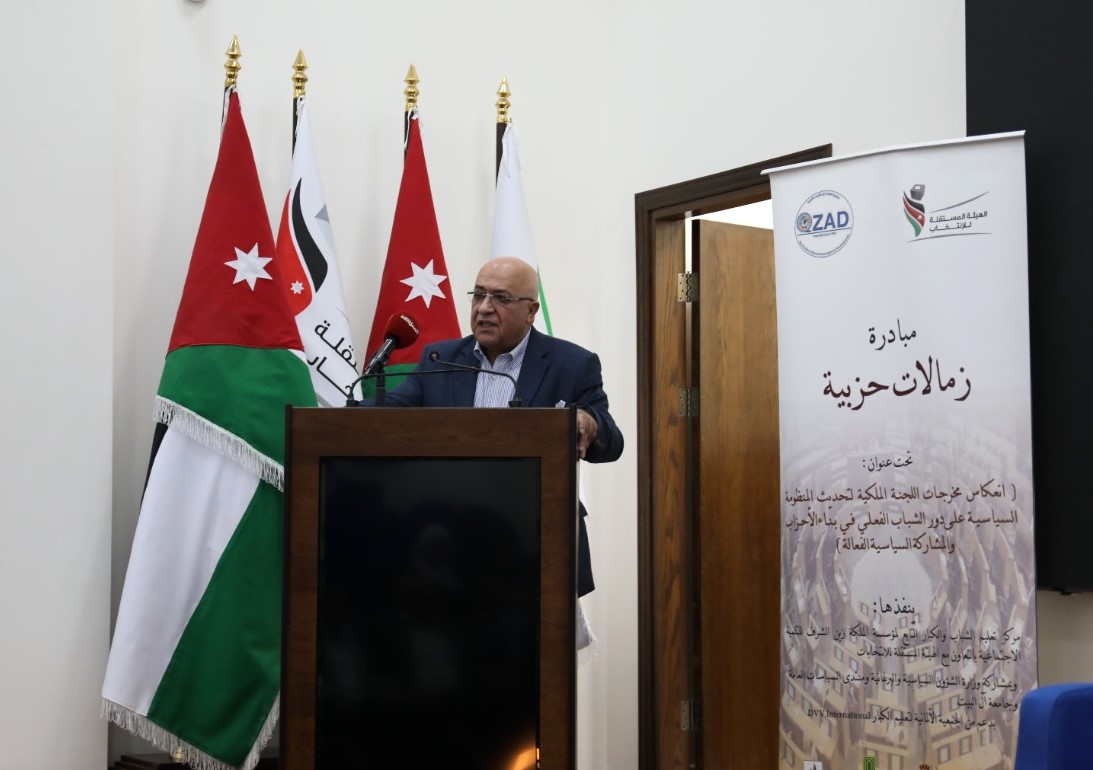
Maaytah: Our youth should know that the solution is through participation and through partisan work
19 October 2022
Maaytah: Our youth should know that the solution is through participation and through partisan work
Maaytah: We must rise to the thought of our youth instead of dragging them backwards
Maaytah: The title of the next phase is the rule of law and partisan work
Maaytah: His Majesty the King and His Highness the Crown Prince's directives to promote youth participation are our main support
The Independent Election Commission launched today a partisan fellowship initiative, as part of a series of educational fellowships implemented by the Queen Zain Al-Sharaf Society for Social Development, in cooperation with the Ministry of Political and Parliamentary Affairs, the Public Policy Forum, and Al al-Bayt University.
The Chairman of the Board of Commissioners of the Independent Election Commission, Eng. Musa Al-Maaytah, stressed that the Independent Election Commission, since it launched the national campaign to enhance popular participationentitled (The Solution is Participation), has been keen to reach groups that were reluctant to participate politically, or participate in unacceptable proportions, and we have begun to see a clear change in their attitudes and ideas in the importance of participation, and today we seek to promote these ideas and orientations to plant feelings and values inherent tothem, such as citizenship, the rule of law, and enabling the language of dialogue and acceptance of the other.
Al-Maaytah pointed out that stimulating the participation of young people in parties is a national responsibility, as the legislative frameworks are ready and success is not complete without implementation, starting with civic education and the application of the party work system in universities, and pushing them to invest in what the new laws have presented to them, and providing them with a positive model inany upcoming electoral process, to form the successful model that he wants, in response to the directives of His Majesty the King and His Highness the Crown Prince to stimulate youth participation, provide them with all forms of support and empower them politically.
Maaytah added that young people today must know that the solution is through participation and through partisan and collective work, so the arena can no longer tolerate individual cases, dispersion and rejection of the other, but rather integration within clear and systematic programs, which we must elevate to the thought of our national youth instead of dragging them back, as time does not go back.
For her part, the Chairperson of the Board of Directors of the Queen Zein Al-Sharaf Society for Development, Dr. Areej Tlilan, spoke about the importance of cooperation and coordination with the national institutions regulating political work in Jordan, and maximizing the success of their efforts in this field of political modernization.
She called for the need to focus on the youth category, especially in universities, andmotivate them to engage in partisan work, stressing the qualitative shift witnessed by party life after the recommendations of the Royal Committee for the Modernization of the Political System, which reflected positively on the reality of youth and women.
On the sidelines of the initiator, a dialogue meeting was held in which Dr. Raed Al-Adwan, member of the Board of Commissioners of the Independent Election Commission,Dr. Ali Al-Khawaldeh, Secretary-General of the Ministry of Political and Parliamentary Affairs, and Khaled Al-Bakkar, member of the Jordanian Senate, where the speakers addressed the roles assigned to the Independent Election Commission, especially in light of its management and supervision of the file of political parties, in addition to the laws governing political life (election and parties laws), and the speakers also dealt with legislation and constitutional amendments aimed at increasing Participation in political life, especially youth and women, and qualifying them for decision-making positions.
At the end of the meeting, an open discussion was held in which the speakers answered questions from the audience, followed by a review of the most important recommendations and outputs.
